Sunday, September 23, 2007

Responsible Stewardship

Message from Fr. Jose Koluthara, CMI

My Dear Brothers and Sisters,

The documentary “An Inconvenient Truth” by Al Gore informs the public about the consequences of abusing the earth and its resources. A combination of human ignorance, greed and indifference has resulted in an excess of carbon dioxide in the atmosphere, creating what scientists call global warming. As a result of this preventable phenomenon, glaciers are melting, plants and animals lose their natural habitats, severe storms and droughts are much more frequent. The number of category 4 and category 5 hurricanes has doubled in the last 30 years. Global warming has also caused malaria to spread well beyond the tropics to higher altitudes. Unless this warming is checked, scientists predict that more than a million species could be driven to extinction by 2050.

Today’s liturgy, especially in the first reading (Amos 8:4-7) and Gospel (Lk 6:1-13) , makes it clear that a sense of stewardship is expected of believers. Amos was convinced that such stewardship was inseparable from justice – not mere legal or ethical or retributive justice, but biblical justice, that is fidelity to the demands of a relationship. For believers this relationship binds each to God, and in God to all others. Relating to this biblical justice, author Walter Burghardt affirms that justice and stewardship it dictates concerns relationships to God, to people and to the earth. (“Justice: A Global Adventure”, N.Y. 2004) Love God, says Burghardt, love every human person, enemy as well as friend, as a child of God, fashioned in God’s image. Touch things – God’s material creation – with respect and reverence, as gifts to be shared generously.

Amos was convinced that such justice was to govern all interpersonal dealings, especially between the rich and the poor. As just stewards of this earth’s goods those who have must address needs of those who have not; justice demands a stewardship that cares and shares. When Amos was ignored, he was harsh in his criticisms and chastisements.

When the steward featured in today’s Gospel found himself among the “have-nots” of his society, he took means to assure his survival. Though dishonesty cost him his job, he is praised by Jesus for taking the initiative to save himself and secure his future. Similarly imaginative and even risky measures are required of Jesus’ disciples today. We are stewards of the earth and upholders of justice, and so we are thereby responsible for one another and all others in Christ.


Stewardship Toronto

Sunday, September 16, 2007

Lost and Found

Message from Fr. Jose Koluthara, CMI

My Dear Brothers and Sisters,

image According to a study released in October 2002, by the National Center for Missing and Exploited Children, an estimated 797,500 children were reported missing in the United States in 1999. Of these children who go missing, too small a fraction are recovered. When a child is found and returned home, that homecoming is marked by a relief and rejoicing that cannot be measured.

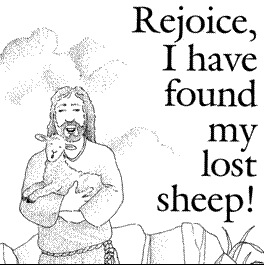
Having tapped into the contemporary pathos that surrounds children lost and children found, let us allow those strong deep feelings to enable our better understanding and appreciation of today’s scripture readings. In the first reading from the book of Exodus, it is the nation of Israel, God’s chosen sons and daughters, who have lost their way. Rather than remain faithful to God in whose image they had been created they preferred to bow down before images that they themselves had created. This golden calf represented a willful and disobedient departure from God. Nevertheless, God, through Moses’ mediation, welcomed back the prodigal people and was reconciled with them. Israel’s story of returning home to God anticipates and complements the Gospel wherein a lost sheep will be found, a lost coin will be retrieved and a lost son will be restored to the love of his father and the secure comfort of his home.

Today’s second reading will draw us into the experience of Paul. Describing his own as a life of loss and sin, Paul regarded his encounter with Christ on a Damascus road as the moment he was found, forgiven and saved. Moreover, he offers his readers the example of his own experience as a pledge of what God can and will do for all who are lost in sin.

The experience of the wayward son featured in today’s Gospel (Lk 15:1-32) is also represented as an example and pledge of God’s loving mercy for sinners. So extreme was the son’s experience of being lost that Luke refers to him two times as being dead (Lk. 15: 24, 32). His experience of being found is so exuberant that it is twice equated with being alive. As Fred Craddock has explained in his book “Luke” there is something worse than death: being lost and alienated from a forgiving God. So also there is something better than life: being found and welcomed home.

Sunday, September 09, 2007

Challenges To Discipleship

Message from Fr. Jose Koluthara, CMI

My Dear Brothers and Sisters,

In answering to Jesus’ call, each must willingly enter into a process of becoming first human, then Christian, then a disciple. This process of growth and development is born in the realization that all human persons are created in the image and likeness of their Creator. Created in the image of Love, human beings are to love and not hate, reverence and not abuse, care for and not curse others, make peace with one another and refrain from every inclination toward violence. Created in God’s likeness, human beings are to preserve and protect life rather than destroy it or lessen its dignity.

Human beings are also called to conform to the image of God incarnate, Jesus Christ (Rom.8:29). Jesus gave his all (“he emptied himself”, Phil 2:7) when he accepted the invitation to act as a disciple in the ways and the will of God. In the same way, those to become his followers are challenged to give all of themselves. Each of the readings for today’s liturgy references something of that incalculable cost of discipleship.

The author of the 1st reading (Wisdom 9:13-18) advises readers to entrust themselves to the wisdom of God. Rather than insist on their own will, make their own plans and seek the satisfaction of their own desires, each should allow the “holy spirit from on high” to plot the path that will lead them to God.

In the second reading, Paul shares with his friend Philemon the very high price his discipleship required of him. Imprisoned for his beliefs and his service to the Gospel, Paul did not regard himself as a helpless victim unjustly accused, but as an ambassador whose privilege it was to be an image of Christ in the world.

In the Gospel, Jesus calls Christians to do three things: First, each must love Jesus best and first and formulate a value system that clearly reflects that love. This Gospel does not advocate a cold-hearted detachment from others but a genuine love of Jesus that inspires and purifies all other loves. Second, among the challenges to discipleship set forth in today’s Gospel is a willingness to imitate Jesus so completely as to embrace the daily crosses that are inherent in that commitment. Finally, Jesus calls for a sensible decisiveness as regards the cost of persevering discipleship. Have I accepted Jesus’ challenges? Am I ready to meet the costly demands of discipleship?

Sunday, September 02, 2007

Humility and Reverence

Message from Fr. Jose Koluthara, CMI

My Dear Brothers and Sisters,

Today’s scripture passages (Sirach 3:17-20,28-29, Lk. 14:1,7-14) call us to humility, which is an important virtue for all those who worship. Humility is ultimately a simple thing. It means accepting the truth about reality. It requires recognizing both the good that God has put into us and the limitations that are inherent in our human nature. In particular, it means never forgetting that God is God and we are not! Humility means giving everyone his or her due, including God and every human being. False pride, sinful pride, takes over when we begin to think of ourselves as superior to others or equal to God.

True worship always involves humility because it acknowledges God as God and sets us in proper relationship to God. This is ultimately what is meant by reverence in worship. Dr. Paul Woodriff, in his book “Reverence: Recovering a Forgotten Virtue”, says that reverence is the opposite of hubris, that false pride that always ultimately leads to our downfall.

It is a constant temptation for those of us who know and love the liturgy to begin to think of ourselves as somehow superior to the “ordinary” worshipper. Therefore we deserve to have our needs and wishes respected! It is true of course, that leaders must make decisions for a community or else they are not leaders. But it is true that leaders must listen very carefully to others in the community if they are to remain its true servants. Such listening requires humility on the part of those in leadership positions.

Does the weekly liturgy lead us to an ever deeper awareness of the presence of the divine mystery at the heart of worship? Are members of the assembly sufficiently attentive to Christ’s presence in one another, in the presider, in the word and in the meal? What can increase in everyone’s awareness of the power of God at work in our midst and in our worship?

One key to remember: Silence fosters reverence, because when we are silent we are not promoting ourselves, and we just might hear the voice of God who rules the universe and yet love each of us dearly.

Sunday, August 26, 2007

Reach Out In Welcome To All

Message from Fr. Jose Koluthara, CMI

My Dear Brothers and Sisters,

“Make every effort to enter through the narrow door” In his autobiography, Mohandas K. Gandhi, wrote that in his student days he was truly interested in the Bible. Deeply moved by the message of the Gospels, he seriously considered becoming a convert since Christianity seemed to offer a real solution to the caste system that divided the people of India. One Sunday Gandhi went to a nearby church to attend services. He decided to see the minister and ask for instruction in the way of salvation and enlightenment on other doctrines. But when he entered the church, the ushers refused to seat him and suggested that he go and worship with his own kind. Gandhi left and did not return. “If Christians have caste differences also”, he said to himself, “I might as well remain a Hindu”.

Today, the Gospel (Lk. 13:22-30) and the first reading from Isaiah (66:18-21) challenge that attitude among Christians who would leave a Gandhi without a seat in church or a welcome into the community. Why was he turned away? The colour of his skin? His insistence on non-violence? Whatever the cause of his rejection, the experience of Gandhi and the experiences of any who are excluded call out to us to remember God’s universal and loving intent for humankind. “I come to gather nations of every language”, proclaims the God of the prophets’ vision (Is. 66:18-21). “People will come from the east and west, from the north and south”, declares Jesus. All are welcome to take their place at the banquet feast in the kingdom. But Isaiah’s mission and Jesus’ invitation are not simply otherworldly ideals. Rather, the universality of the prophet’s vision and the inclusivity of Jesus’ portrayal of the kingdom are to be started here and now among all who would be Jesus’ disciples.

From the second reading (Heb. 12:5-7) we learn that accepting others fully, freely and without reservation requires a daily discipline of will. One of those small steps toward inclusiveness might simply be reaching out with genuine interest to listen to the ideas of another with whom we are usually too ready to disagree. This genuine listening will preclude my formulating an answer until I have completely heard the other person’s thought.

Just as Jesus reached out in welcome and acceptance to all, so must those who would call themselves his own.

Sunday, November 20, 2005

Liturgy of our Lives

Message from Fr. Jose Koluthara, CMI

My Dear Brothers and Sisters:
We are standing together on the threshold of a liturgical year now ending and another soon to begin. When endings mesh with beginnings, it seems only natural to look over our shoulders at what has transpired in our lives. As we take truthful inventory and determine the measure of who we are, it also seems appropriate that we gather up all that we are and offer it to God as the liturgy of our lives. But just what constitutes that liturgy? How do our lives come together to celebrate the One whose kingship we acknowledge today? What sacrifice have we to offer to the Lord of all life, whose own sacrifice has opened the way to life everlasting for us (1Cor15:20-26,28 2nd reading)?

Centuries ago, the prophets posed similar questions to God on behalf of their contemporaries. How could they make of their lives a liturgy worthy of the character of the God who called them into being? What had they to offer in prayerful thanksgiving and worshipful praise to the God who promised to be their shepherd, rescuing them when they were scattered, bringing them home when they strayed, binding and healing their wounds and giving them a protected rest (Ezek 34:11-12, 15-17, 1st reading)? God’s answer to the prophets’ questioning was challenging as it was simple: “Do justice; love tenderly; walk in truth with God.” In this challenge lies the whole of the law and the prophets; in this challenge lie the seeds of a life-liturgy worthy of God.
In today’s Gospel (Mt 25:34-46), Jesus teaches us the words and the gestures, the symbols and the rituals to the life-liturgy that best acknowledges, thanks, loves and praises God: “I was hungry; you gave me food. I was thirsty; you gave me drink. I was a stranger; you welcomed me. I was in prison; you came to visit me.” These are the prayers of the true-life liturgy without which no other liturgy in church has meaning. If the hungry are not fed, the naked are not clothed, etc., then we have failed to recognize and tend the God who lives among us in these least ones. If the thirsty are not offered drink and the ill and the imprisoned are not visited and cared for, then even when two or three gather, the promised presence of Christ will be lost to us.

If and when we do take the Gospel challenge seriously, let us not think of what we are doing as charity. Let us realize that we are merely beginning to meet the demands of justice, a justice by which we accept to live when we agree to love tenderly and walk in truth with God.


Sunday, November 13, 2005

Be Gift and Grace for Others

Message from Fr. Jose Koluthara, CMI


Do you remember Shel Silverstein’s parable The Giving Tree (Harper and Row Publishers, New York:1964)? “Once there was a tree”, it begins, “and she loved a little boy.” Regularly from the boy’s childhood to his teen years to his adulthood, he came to the tree. When he was a child, he came to climb her trunk, eat her apples and swing from her branches. And the tree was happy. As he matured, his requests for the tree’s particular gifts and talents became more insistent, more costly. First, when the boy needed money she gave her apples to sell, and she was happy. When he needed a home, she gave her branches; when he wanted to get away from it all, she happily gave her trunk for a boat. At long last, the boy who was an old man by now, came back to the tree, who was no more than an old stump. Since all the man wanted now was a place to sit and rest, the tree offered her stump to him. And the tree was happy.


Like Jesus in today’s Gospel (Mt 25:14-30), Silverstein told a parable that captured the essence of what it means to acknowledge our gifts and talents and to place them freely and fully at the service of others. Such generosity with oneself requires the type of risk-taking, that is exemplified in the first two servants in the parable of the talents. Each dared to risk investing all that had been entrusted him by his employer. Neither held back anything even though worldly prudence may have dictated for him to do so. From these risk-taking servants, and from the giving tree, we learn that all comes to us from God as a gift; therefore all should be given as gift, without judging the worthiness of the recipient and with full awareness that what we give may be misused, undervalued or even abused.


In contrast to the two daring servants and the utterly selfless tree, the third servant chose what he thought to be the safe path. He did not risk, he did not give, and in the end even that which had been entrusted to him was rescinded. So it goes with those who refuse to spend their God-given selves, their time, their talent or their treasure for the sake of the kingdom. These may, in the end retain what they have, but what good shall a treasure be that cannot traverse the final passage we know as death?


Today, the parable continues to speak its message, assuring us that we are both gifted and graced, and in that capacity we are to be both gift and grace for others…even if we are only an old stump where another can find rest.